Drop 3–6 Shots in 12 Weeks
You’ve spent thousands on lessons, drivers, and range sessions. Your handicap hasn’t moved. The problem isn’t your swing — it’s that nobody gave you a plan. This is that plan.
You’ve spent thousands on lessons, drivers, and range sessions. Your handicap hasn’t moved. The problem isn’t your swing — it’s that nobody gave you a plan. This is that plan.
Not a new driver. Not a swing overhaul. Not another tip from your mate. Four things the data proves work — and most golfers ignore all of them.

You make the same mistakes every round because nobody taught you how to think on the course. This book fixes that. Course management, green reading, and the strategy that separates improvers from golfers stuck on a plateau.
The Book →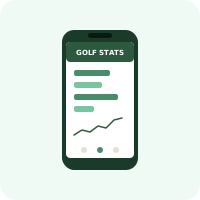
You think your driver is the problem. Your stats say it’s your short game. The app tracks every round, finds where you actually lose shots, and tells you what to fix first.
The App →
Your swing falls apart on the back nine because your body quits before your round does. Golf-specific fitness, flexibility, and speed programs that keep you consistent for 18 holes.
Training Plans →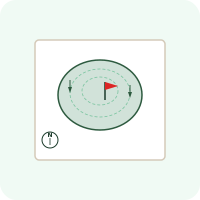
You three-putt because you didn’t read the green before your approach shot. Grand Green Maps give you caddy-level reads — every slope, break, and landing zone mapped out before you step on the tee.
Green Maps →A single golf lesson costs $100+. A new driver costs $600. A year of range balls costs $500. None of them come with a plan. This does — strategy, fitness, course knowledge, and 3 months of AI coaching — for less than the cost of five lessons.
Follow the 12-week plan. If your handicap doesn’t drop by at least 2 shots, email us your scorecards and we’ll refund every cent. No questions, no hassle.
If you just want the strategy, grab the book for $10. If you want to get serious, pick the package that fits. Every purchase includes free app access.
$10
The strategy guide that starts your transformation. Instant access via Google Sheets.
+ 2 weeks Pro app$179.99
Fitness + Stretching + Speed — all 3 golf training plans. Build the physical engine.
+ 1 month Elite app$269.99
Digital Book + All training plans + Green maps. The complete digital package.
+ 3 months Elite app$497
Digital Book + All training + Green Maps + 3 months Elite app. The complete transformation.
+ 3 months Elite appStrokes Gained research proves the average golfer leaves 4–6 shots on the course every round — not from bad swings, but from bad decisions. Yours is costing you and you probably don’t know what it is. Take the free 5-minute assessment — 8 questions, a personalised improvement plan, and a clear next step.
Find Your Blind SpotBefore and after scores from club golfers following The Grand Plan system. No swing changes — just better decisions, structured practice, and a plan.
“I was stuck at 95 for three years. The course management sections showed me I was making hero plays that cost me 3–4 shots every round. Dropped 9 shots in 12 weeks without changing my swing.”
Mark T.
“Finally broke 90. The short game drills and practice structure made the difference. I stopped wasting range sessions hitting driver and started working on what my stats said actually mattered.”
James R.
“I thought my irons were the problem. Turns out putting was where I was bleeding shots. The stats tracking showed me the truth and the practice plans fixed it. Broke 80 for the first time.”
Chris W.
“I’m not a long hitter and I thought that was my problem. The book showed me smarter club selections save more shots than an extra 20 metres off the tee. Dropped 9 shots.”
Lisa W.
“My approach shots were the leak. Once I flipped my practice ratio to 60% short game and approaches, everything changed. Broke 80 and I’m still improving.”
Tom L.
It is the complete Grand Plan system: the Digital Book, all 3 training plans (The Distance Stack), Green Maps (your choice of Grand Green Maps or Blank Templates), and 3 months of Elite app access including AI coaching. Everything delivered digitally — instant access, everything you need to drop 3–6 shots.
The digital book is delivered as a Google Sheet shared to your email. You can access it from any device with a browser — phone, tablet, or computer.
Yes. Whether you are a 36 handicap or a 10, the principles of course management, structured practice, and data-driven improvement apply to every level. Take the free assessment to get personalised recommendations.
Golfers who follow the system typically see 3–6 shots improvement within 12 weeks. The combination of strategy, fitness, and tracking accelerates results beyond any single product.
Every purchase includes free access to the Golf Stats App. You will receive a trial code after checkout — activate it within 30 days to start tracking your rounds and stats.
Yes! Enter your promo code on the cart page before checkout. Discounts are applied automatically at payment.
The 12-Week Breakthrough System comes with a 90-Day Score-Drop Guarantee. Follow the plan for 12 weeks. If your handicap doesn’t drop by at least 2 shots, email us your scorecards and we’ll refund every cent. No questions, no hassle. The book and individual products are risk-free at their price points — you’ll know within one round whether the approach clicks.
The Breakthrough System comes with a 90-Day Score-Drop Guarantee — follow the plan, and if your handicap doesn’t drop by at least 2 shots, you get every cent back. And the book is just $10. Less than a sleeve of balls. Either way, you can’t lose.
The same principles from the book, delivered one lesson per day. Five emails. Five strategies you can use in your next round. No spam, unsubscribe anytime.